The AI ROI Scorecard: How to Know Whether Your AI Investment Is Actually Working
- Eric Goldman

- 4 days ago
- 5 min read
Updated: 2 days ago
Artificial intelligence spending is accelerating, but measurable returns are not keeping pace.
According to BCG, companies expect to more than double their AI spending in 2026, increasing it from approximately 0.8% to 1.7% of revenue. Yet PwC reports that 56% of CEOs have realized neither increased revenue nor reduced costs from their AI investments over the past year.
The problem is not necessarily that AI is failing. In many cases, businesses simply have not defined what success should look like or established a reliable way to measure it.
A new AI tool gets introduced, employees begin experimenting with it, and leaders hear anecdotal reports about time savings and improved productivity. But when someone asks how much value the investment has actually created, the answer is often unclear.
An AI ROI scorecard helps close that gap. It gives leaders a structured way to determine whether an AI initiative is saving time, reducing costs, creating capacity, improving quality, or contributing to revenue.

Why AI ROI Is Difficult to Measure
Traditional technology investments are often evaluated through relatively straightforward financial metrics. A company purchases a new system, reduces a known expense, and compares the savings with the cost of implementation.
AI is more complicated because much of its initial value appears in less obvious ways.
An employee may use AI to complete a report in two hours instead of four. A customer service team may respond more quickly. A manager may make a better decision because information was summarized more effectively. An automated workflow may prevent errors or reduce the likelihood that an important task falls through the cracks.
These improvements matter, but they do not automatically appear on an income statement.
This creates a common measurement mistake: businesses count activity instead of results. The number of AI licenses, prompts, users, or automated tasks may demonstrate adoption, but it does not prove business value.
The real question is not, “How much are we using AI?”
It is, “What has improved because we are using it?”
Begin With the Business Outcome
Before measuring AI ROI, leaders need to define the business problem the initiative is expected to solve.
Consider an accounting firm that introduces an AI assistant to summarize client documents. The objective should not simply be to “use AI for document review.” A more useful objective would be to reduce the time required to prepare for a client meeting from 90 minutes to 45 minutes without reducing accuracy.
That objective establishes three things:
The process being improved
The current performance baseline
The result the organization expects to achieve
Without a baseline, almost any improvement can sound impressive. A team might report saving 500 hours, but that number has little meaning unless leadership understands how those hours were previously spent, what the AI system cost, and what the team accomplished with the recovered capacity.
This is why ROI measurement must begin before implementation, not after it.

The Four Measures of an AI ROI Scorecard
A practical AI ROI scorecard should evaluate four dimensions. Not every initiative will improve all four, but it should produce measurable progress in at least one.
1. Efficiency and Capacity
The first measure is whether AI helps employees accomplish more with the same resources. This may include reducing the time spent drafting communications, searching for information, preparing reports, entering data, or coordinating work.
Time saved should be connected to a business result. If an AI workflow creates 100 hours of monthly capacity, determine how those hours are used. Can the team serve more clients, complete projects faster, reduce overtime, or avoid an additional hire?
Efficiency creates value when recovered time is redirected toward productive work.
2. Cost and Risk Reduction
AI can reduce direct expenses, prevent future costs, and lower operational risk. This may include eliminating redundant software, reducing outsourced work, preventing errors, improving compliance, or avoiding unnecessary hiring.
Businesses should track tangible indicators such as:
Operating expenses
Overtime
Error and rework rates
Missed deadlines
Compliance incidents
Customer complaints
Preventing one serious confidentiality breach, compliance failure, or client error may create more value than hundreds of hours of incremental productivity.
3. Revenue and Client Impact
AI may contribute to revenue by improving lead response, accelerating proposals, increasing billable capacity, identifying new opportunities, or strengthening client retention.
The measurement should focus on business outcomes rather than activity. Instead of counting how many proposals AI helped create, track whether conversion rates improved. Instead of counting automated client messages, measure response times, satisfaction, and retention.
This creates a clearer connection between the AI initiative and financial performance.
4. Adoption and Sustainability
Even a technically impressive system produces little value if employees do not use it consistently.
Leaders should monitor active usage, employee satisfaction, manual workarounds, training requirements, and the time employees spend correcting AI-generated outputs.
Low adoption may indicate that the system is difficult to use, poorly integrated, or disconnected from the actual workflow.
The ultimate question is whether the improvement can be sustained. A successful AI initiative should become a reliable part of how work gets done, not another tool employees abandon after the initial excitement fades.

Calculate the Full Cost of the Investment
Businesses often underestimate AI costs by looking only at the monthly software subscription.
The complete investment may include:
Software licenses
Implementation and configuration
Systems integration
Data preparation
Employee training
Internal project-management time
Governance and security controls
Ongoing monitoring and maintenance
Time spent reviewing and correcting AI outputs
Once the total cost and measurable value are established, the basic ROI calculation is:
ROI = (Total measurable value − total investment) ÷ total investment × 100
If an AI initiative creates $75,000 in annual value and costs $30,000 to implement and operate, its first-year ROI is 150%.
The formula is simple. Determining which benefits are real, attributable, and sustainable requires considerably more discipline.
From AI Activity to Business Value
AI ROI should not be measured by excitement, experimentation, or the number of tools an organization has purchased. It should be measured by what has materially improved.
A strong AI ROI scorecard connects each initiative to a defined business problem, establishes a baseline, measures multiple forms of value, accounts for the full investment, and evaluates whether the improvement can be sustained.
This changes the conversation. Instead of asking whether employees like the tool or how frequently they use it, leaders can determine whether the initiative is creating capacity, reducing risk, improving performance, or generating financial returns.
AI Solutions For Real Business Challenges
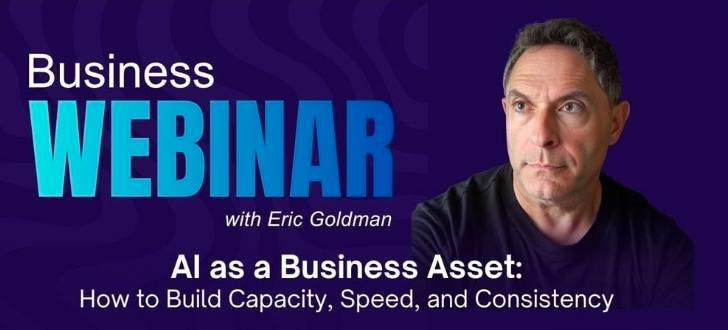
Eric recently presented a webinar on how businesses can use AI to solve real operational needs, rather than simply adding more tools. Watch the webinar to learn how to identify the right opportunities and build a more practical AI strategy. Link to watch webinar on YouTube.
About AI Growth Advisors
Every organization is asking how AI fits into its future. We help answer that question, beginning with: what business challenge are you trying to solve? Book an Introductory Call. We combine business strategy, workflow optimization, governance, and practical AI implementation to help companies increase capacity, improve decision-making, and create a sustainable competitive advantage.
AI Growth Advisors | 100 Shoreline Highway, Mill Valley, CA | 415.572.7770